< Previous | Contents | Next >
The process assessment model offers indicators in order to identify whether the process outcomes and the process attribute outcomes (achievements) are present or absent in the instantiated processes of projects and organizational units. These indicators provide guidance for assessors in accumulating the necessary objective evidence to support judgments of capability. They are not intended to be regarded as a mandatory set of checklists to be followed.
In order to judge the presence or absence of process outcomes and process achievements an assessment obtains objective evidence. All such evidence comes from the examination of work products and repository content of the assessed processes, and from testimony provided by the performers and managers of the assessed processes. This evidence is mapped to the PAM indicators to allow establishing the correspondence to the relevant process outcomes and process attribute achievements.
There are two types of indicators:
Process performance indicators, which apply exclusively to capability Level 1. They provide an indication of the extent of fulfillment of the process outcomes
Process capability indicators, which apply to Capability Levels 2 to 5. They provide an indication of the extent of fulfillment of the process attribute achievements.
Assessment indicators are used to confirm that certain practices were performed, as shown by evidence collected during an assessment. All such evidence comes either from the examination of work products of the processes assessed, or from statements made by the performers and managers of the processes. The existence of base practices and work products provide evidence of the performance of the processes associated with them. Similarly, the existence of process capability indicators provides evidence of process capability.
The evidence obtained should be recorded in a form that clearly relates to an associated indicator, in order that support for the assessor’s judgment can be confirmed or verified as required by ISO/IEC 33002.
3.3.1. Process performance indicators
Types of process performance indicators are
Base practices (BP)
Work products (WP).
Both BPs and WPs relate to one or more process outcomes. Consequently, BPs and WPs are always process-specific and not generic. BPs represent activity-oriented indicators. WPs represent result- oriented indicators. Both BP and WP are used for judging objective evidence that an assessor is to collect, and accumulate, in the performance of an assessment. In that respect BPs and WPs are alternative indicator sets the assessor can use.
The PAM offers a set of work product characteristics (WPC, see Annex B) for each WP. These are meant to offer a good practice and state-of-the-art knowledge guide for the assessor. Therefore, WP and WPC are supposed to be a quickly accessible information source during an assessment. In that respect WPs and WPCs represent an example structure only. They are neither a "strict must" nor are they normative for organizations. Instead, the actual structure, form and content of concrete work products and documents for the implemented processes must be defined by the project and organization, respectively. The project and/or organization ensures that the work products are appropriate for the intended purpose and needs, and in relation to the development goals.
3.3.2. Process capability indicators
Types of process capability indicators are:
Generic Practice (GP)
Generic Resource (GR)
Both GPs and GRs relate to one or more PA Achievements. In contrast to process performance indicators, however, they are of generic type, i.e. they apply to any process.
The difference between GP and GR is that the former represent activity-oriented indicators while the latter represent infrastructure- oriented indicators for judging objective evidence. An assessor has to collect and accumulate evidence supporting process capability indicators during an assessment. In that respect GPs and GRs are alternative indicators sets the assessor can use.
In spite of the fact that level 1 capability of a process is only characterized by the measure of the extent to which the process outcomes are achieved the measurement framework (see chapter 3.2) requires each level to reveal a process attribute, and, thus, requires the PAM to introduce at least one process capability indicator. Therefore, the only process performance attribute for capability Level 1 (PA.1.1) has a single generic practice (GP 1.1.1) pointing as an editorial reference to the respective process performance indicators (see Figure 3).
CL 5 PA 5.2
PA 5.1
GPs, GRs
CL 4 PA 4.2
PA 4.1
CL 3 PA 3.1
PA 3.2
CL 2 PA 2.2
PA 2.1
GPs, GRs
CL 1
GP
BPs, WPs and WPCs
Process assessment model (Automotive SPICE)
Process capability indicators
Process performance indicators
PA 1.1


Measurement framework (ISO/IEC 33020)
Capability levels
Process attributes
Rating
Scale
Rating method
Aggregation method
Process capability level model
Outcomes of


Process reference model (Automotive SPICE)
Domain and scopes
Process purposes
Process outcomes
process 1
Outcomes of
process 2
Outcomes of
process 3
Figure 3 — Relationship between assessment indicators and process capability
3.3.3. Understanding the level of abstraction of a PAM
The term "process" can be understood at three levels of abstraction. Note that these levels of abstraction are not meant to define a strict black-or-white split, nor is it the aim to provide a scientific classification schema – the message here is to understand that, in practice, when it comes to the term "process" there are different abstraction levels, and that a PAM resides at the highest.


Process Assessment Model(s)
The "What" (Goals of the process)

Methods

Execution
The "How"
What is to be done
Why it has to be done
What are the technical dependencies

Methods, tools, templates, metrics
Definitions of logical order, concrete workflows
Authority and competence definitions
(How to achieve the goals)
Tailoring
Setup
Performance according to the tailored method
The "Doing"

(Performing the tasks to achieve the goals by using the methods)
Figure 4 — Possible levels of abstraction for the term "process"
Capturing experience acquired during product development (i.e. at the DOING level) in order to share this experience with others means creating a HOW level. However, a HOW is always specific to a particular context such as a company, an organizational unit, or a product line. For example, the HOW of a project, organizational unit, or company A is potentially not applicable as is to a project, organizational unit, or company B. However, both might be expected to adhere the principles represented by PAM indicators for process outcomes and process attribute achievements. These indicators are at the WHAT level while deciding on solutions for concrete templates, proceedings, and tooling etc. is left to the HOW level.

Methods
Process Assessment Model(s)
Execution
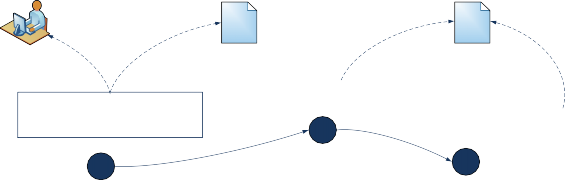
Performing interviews on the actual "Doing",
Investigating work products and tool repositories, …
Reading through the defined "How"
… and determine the capability profile.
… mapping the information to the indicators ...
Figure 5 — Performing a process assessment for determining process capability